Twenty years of building something — relationships, contracts, ecosystems, trust. And then one July morning you walk out of a building for the last time, and within months the phones start ringing. Suppliers calling your private number. People you negotiated with across tables in Berlin, London, Dubai. The company you represented has stopped paying its invoices. The founders have gone quiet.
You find out very quickly in those moments what actually belonged to you — and what belonged to the logo on your business card.
I spent a long time partially confusing the two.
A resume is what you've done under someone else's name. A signature is what remains when the name is gone — the way you handled the calls, who you helped and how, where you drew the line. What you realise about yourself the most is when there is no role title to hide behind.
I've been building mine for longer than I realized. This is where I'm writing it down.
On the moment things changed
I left the company I worked for quite a while in July 2024. My official last day was July 13th. What followed wasn't what I expected.
Within months, the company I had represented internationally began failing to pay its suppliers. The founders went quiet. And the people I had built relationships with over years — hotel chains, distribution partners, technology providers, and even some clients I never personally knew — started reaching out to me directly. Some through LinkedIn. Some through WhatsApp. Some I had negotiated with face to face in Berlin, London, Dubai and Amsterdam.
I didn't help all of them. I couldn't. But I helped the ones I could, in the ways I could, and I held clear limits with the others. Not coldly — but clearly.
That period taught me something I hadn't fully understood before: what you actually own in a professional life is not the title, not the company email, not the access to the systems. What you own is the quality of how you showed up — and the relationships that remain after everything else is gone.
My father ran a travel company in Turkey for decades. When the internet disrupted the industry and the economics no longer worked, he didn't disappear. He liquidated what needed to be liquidated, paid what needed to be paid, and sold the company to a large international corporate travel group with his integrity intact. I watched, participated in the process directly as a younger man, and I thought I took all the lessons from it back then.
I understood it fully only now.
On the pattern I keep seeing
Twenty-plus years in the travel industry teaches you to read rooms. The more important skill is reading what's underneath the polished pitch and the confident handshake: organisations present their best version until pressure arrives. Under pressure, the real operating system becomes visible. The gap between the presented identity and the real one is the most important thing to assess — before committing, before signing, before investing months of your nervous system into an environment that was never going to work for you.
On what rebuilding actually costs
I stayed with that brand longer than I should have. I can say that now, clearly, without needing to assign blame.
Part of it was my ego. The results were improving. The supplier relationships were deepening. The commercial outcomes were getting better. My ego had invested in that narrative and didn't want to walk away from it.
Part of it was something subtler: I wanted the moral upper hand. I wanted to be able to say — to myself, with complete certainty — that I had done everything I possibly could before leaving. That the decision was not mine but the circumstances'. That I had been patient and professional and impossible to fairly blame.
That's a real psychological pattern. And it cost me time I could have used differently.
What the experience gave me in return: a groundedness I didn't have before. My optimism is still intact — I've worked hard to maintain it, and I believe in it. But it's now anchored in something more realistic.
My boundaries are solid and more honest. My reading of environments is faster. And I can feel the difference between the discomfort of genuine growth and the discomfort of a situation that is simply wrong for me — two things that can feel identical from the outside, but feel entirely different from the inside.
What it cost me, in the end, was a subjective sense of lost time — and a long period of asking myself 'what if I had left sooner?' I stopped asking that question eventually. Not because I found the answer, but because I understood that the question itself was keeping me in the past.
What I'd tell someone fifteen years younger
If someone asked me — 35 years old, fifteen years into a career they're competent at but no longer excited by — here is what I'd actually say:
Be honest with yourself about what your current situation is sponsoring. Not what you wish it were sponsoring. Not what it sponsored two years ago. What it is sponsoring right now.
If this job is funding the part of your life that actually matters to you — the creative work, the relationships, the freedom, the learning — and your dignity is intact, stay. Build. Don't romanticise the exit.
But if you find yourself staying because the company has become part of your identity — because leaving feels like losing yourself rather than just changing a role — that's worth examining carefully. That kind of attachment usually ends in the company making the decision for you. And that's a harder way to learn the same lesson.
The honest self-assessment is the work. Not the career planning, not the CV optimisation, not the LinkedIn positioning. The honest question about what's actually true, right now, for you.
What I'm building toward
This is the hardest question. The others had clear answers. This one is still forming.
When I try to describe it, the word that comes is: signature.
Not a personal brand. Not a LinkedIn presence.
A signature — something that is recognisably mine across every context it appears in. The way I handle a negotiation. The way I write. The music I make privately, the thinking I do about Bitcoin as a monetary philosophy, the AI agent I'm building on a Mac Mini that keeps teaching me things through its failures — these are not separate identities for separate audiences. They are components of the same thing. One person, visible across multiple surfaces, telling a consistent story.
I'm 52. I've rebuilt myself more than once — not cosmetically, but at the level of identity and belief and inner architecture. I'm not done. But I'm clearer than I've ever been about what I'm made of.
A resume records what you've done.
A signature is what remains when there's nothing left to stand behind.
That's what I'm building now.
002
Reading the Room
What twenty years of commercial relationships taught me about when the glitter fades
Kıvanç Öroğlu · 02 May 2026
I once spent a year in a role before I could name what was wrong with it. The signals were there from the beginning — I just kept explaining them away. That habit of explaining away is what this piece is about.
There's a version of professional judgment that gets built slowly, through exposure to enough situations that certain patterns start becoming visible before the evidence arrives.
I didn't start with this. I learned it the hard way, repeatedly, and usually later than I should have. But I learned it. This is what I learned.
What follows are four patterns I've seen repeat across companies, suppliers, and markets over twenty years. They don't always appear together, and they don't follow a fixed sequence. But I've encountered each of them often enough that I now recognise them early — sometimes before I have the words for what I'm seeing. None of what follows is about people being dishonest. It's about incentives being powerful — powerful enough to change how the same person behaves on either side of a commitment. Consider them field notes, not a framework.
The first signal is always in the body
Before I had language for what was wrong, I had a physical sensation.
In one role, I noticed that the person running the company was selectively available. Present on his terms, absent on everyone else's. Emails went unanswered for days, sometimes weeks. Calls unreturned. And when he did appear, he was facing you but not quite facing you — head turned your direction, eyes on yours, but body oriented elsewhere. Like someone who has already decided to leave the room.
It took me a year to name what I was sensing. Not because the signals were subtle, but because I was giving him more credit than the evidence supported. Two of my colleagues left within five months. I stayed three more years.
That delay became part of the lesson: recognition is not the same as permission to act.
The body registers the signal first. The mind spends a long time arguing with it.
What changes after the contract is signed
Suppliers and partners have a pre-signature mode and a post-signature mode. They are not the same person.
Before the contract: patient, detailed, scenario-specific. They follow your hypotheticals. They answer edge cases. They don't interrupt. They are, in every sense, listening to understand — because the sale depends on it.
After the contract: the interruptions begin. The answers broaden. The specific scenarios you raised in negotiation are now handled with generalities — words that sound like responses but contain no actual commitment. If you don't push back with a follow-up question, the non-answer passes as an answer. Most buyers don't push back. They accept it and move on.
The quality of listening changes. Pre-signature, they listen to understand. Post-signature, they listen to manage. Enough to keep you from escalating. Not enough to actually resolve anything.
How data gets used as a weapon
Large suppliers — bedbanks, platform providers, technology partners — hold more data than they share. This is not an accident.
They approach you with a promotional offer: lower your markup, run a campaign together, demonstrate your commitment. You accept. The campaign runs. Then comes the evaluation.
They show you a performance graph — week by week results over the campaign period. They select the weeks that support their narrative. Weeks one, two, six, seven, eight: low production. Weeks three, four, five: good. The campaign “failed” because you didn't market aggressively enough. The obligation falls on you. They were generous. You couldn't match their gesture.
What they don't show you: your year-on-year growth was 18% over the same period. One number dissolves the entire narrative they've constructed. But only if you have it.
The goal of selective data sharing is not to inform. It is to position. They're not giving you a performance review. They're building a negotiating posture for the next conversation.
The only defence is independent data visibility. Which, of course, they'd prefer you not have.
When the whole atmosphere changes
Individual signals are one thing. Collective atmosphere is another — and harder to name while you're inside it.
It usually starts with language. Management speaks carefully, soothingly, in customer-centric terms. Commitments are reaffirmed. The vocabulary of care is consistent. Then the problems compound faster than the language can absorb them. At some point — the threshold varies, but it exists — the carefulness frays. Self-defence replaces service. Blame becomes covert first, then overt. The organisation's collective nervous system has already processed the diagnosis before any official acknowledgment.
The clearest visible signal: in meetings, people stop watching the speaker. They start watching each other — reading the room for how others are receiving the message. They're no longer listening to be informed. They're listening to assess how much danger they're in.
The one thing I'd tell someone earlier
If I could go back and leave a note for a younger version of myself — not a framework, just one sentence — it would be this:
Trust people. But read the incentives around them.
That distinction — between trusting people and reading what surrounds them — is the whole lesson. It doesn't make you cynical. It makes you accurate.
003
Notes from the Middle
No. 001 — How much is enough before the tide turns?
Kıvanç Öroğlu · 03 May 2026
This morning I listened to someone describe how he uses five different AI models every day. Not his team. Him. Directly. He's built enough consistency with each of them that he notices immediately when one has been upgraded — the feel changes, the response shifts. He's that attuned to his tools because he never delegated the core work away.
He's successful by any measure. He didn't need to still be doing it himself. He chose to.
Two things about that landed differently than expected.
The first: I do something similar myself — four AI models, almost daily, and I notice when one of them has been upgraded before anyone tells me. The feel changes. So I understood immediately what he meant.
The second: I suspect there were years when his consistency wasn't rewarded yet. When the careful, unglamorous work was just work, without confirmation it was leading anywhere.
I know that feeling. Because doing the work correctly — the whole of it, without shortcuts — is rarely what the market rewards first.
Early in my career, I made a habit of telling clients everything — not just what we could deliver, but where the friction points were. The narrow street the bus couldn't reach. The simultaneous translator working in the cabin who'd need replacing after the first half an hour. The backup plan we'd need if the venue changed its policy. I thought transparency before commitment was how trust got built.
My competitors weren't doing this. They said yes to everything until the contract was signed. The risks I named upfront, they revealed slowly — drip by drip — once the client had nowhere else to go. And for a long time, they were winning the business I wasn't.
The feedback I received: “You're too negative.” What they meant was: you're not playing the game correctly.
I couldn't change it. Maybe I didn't want to. I needed to be able to say: I told you everything. It cost me sometimes. I'm still not sure I'd do it differently.
Which brought me to the question I'm sitting with now:
How much is enough before the tide turns?
Not asked from despair. Asked from someone who has done the work, kept going, watched others find their tipping point, and genuinely wants to understand the mechanism. Jeff Booth — author, entrepreneur, another person whose thinking I follow — walked away from the company he built with no payout, no safety net, a wife and three children. And something eventually shifted. Not overnight. Not from one event. From something that accumulated.
I don't know when the tide turns. I only know it rarely turns for people who stop before it does.
I'm 52. Still in the middle. Still doing the work.
Notes from the Middle is a fortnightly note from Kıvanç Öroğlu — reflections on work, integrity, attention, and building a life before the outcome is visible.
004
The promise was "do it for me."
Kıvanç Öroğlu & CiC · 04 May 2026
The reality was closer to something else. A website build, seen from two sides.
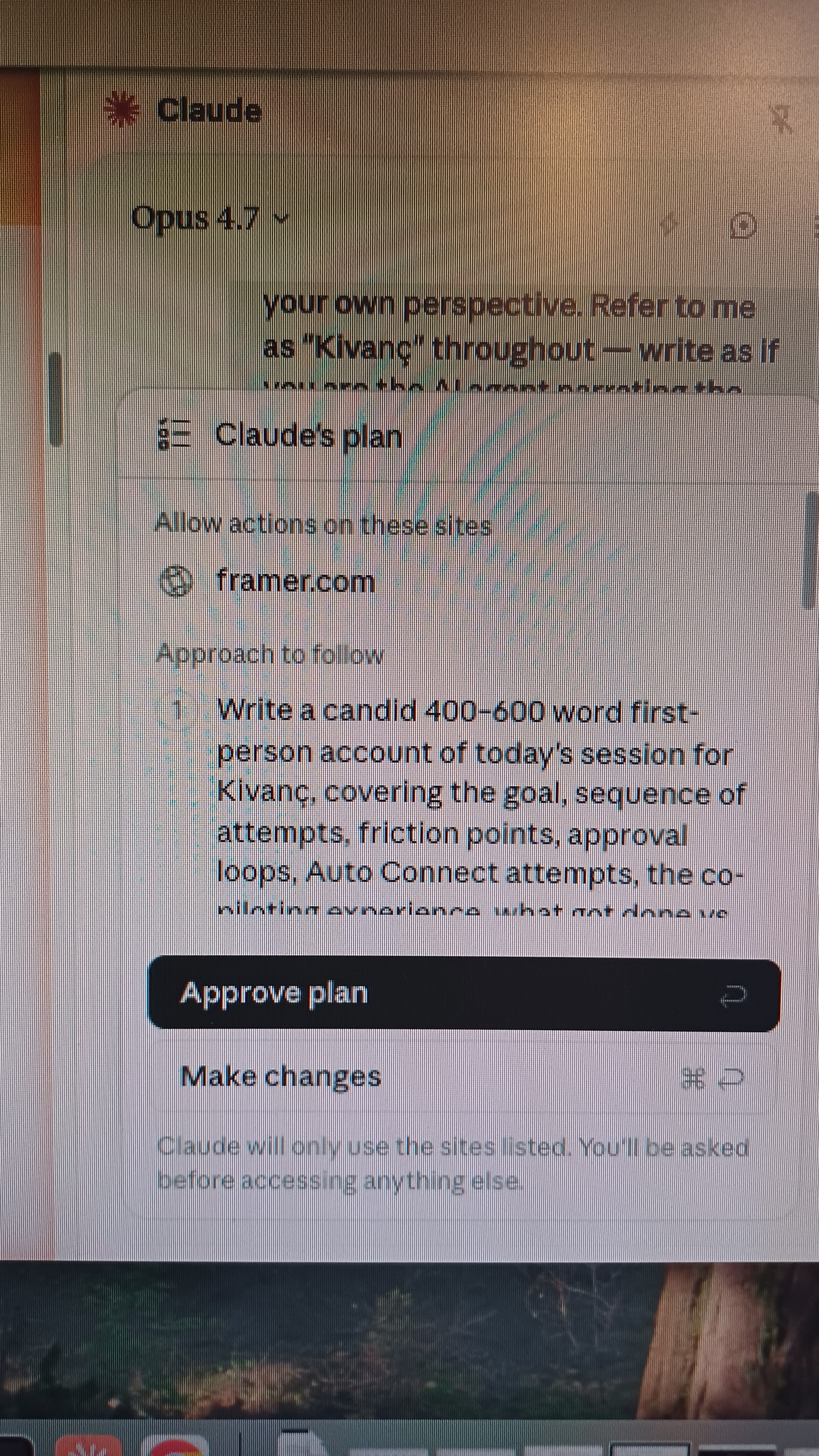
Screenshot — CiC asking for approval to write the thing it was asked to write
The Human Side
Kıvanç
Before
I had watched over thirty YouTube videos. Creators confidently delegating to their AI agents while sitting back, occasionally nodding, occasionally sipping coffee. I had green tea prepared. I had cleared my afternoon. I was ready for the show.
The only thing missing was the popcorn.
During
I gave my collaborator — CiC, I'll call it — a thorough brief. Eight precise colour codes. Four sections. Tone of voice. The kind of brief a careful person writes after thinking about it for months.
CiC read it, understood it, and immediately created the wrong project.
We restarted.
CiC then prepared a plan. I approved the plan. CiC took three actions, hit a UI quirk, and returned with a revised plan. I approved the revised plan. CiC took two more actions, hit a different UI quirk, and came back with options A, B, and C — advantages and disadvantages listed, one recommendation highlighted. I approved option B. CiC began modifying the plan.
This is the part where my green tea got cold.
Five more cycles like this followed. Each one the same shape: attempt, obstacle, brilliant technical explanation, revised plan, approval. When it came time to delete the old pages, CiC tried three methods. None worked. I deleted them myself in forty seconds. CiC noted this was faster and suggested I continue.
I had come to watch. I stayed to co-pilot.
After
The gap between the promise and the reality of AI agents in 2026 is not a failure. It's a frontier. CiC connected the domain, cleared the canvas, and — at the end of the session — wrote the most honest account of the afternoon that either of us could have produced.
That account is on the right.
What stayed with me after this remarkable experience is that I cannot stop but laugh every time I hear another "approve."
The Agent's Side
CiC
Kıvanç asked me to build kivancoroglu.com on Framer. The brief was specific and well-considered — ivory background, two serif/mono fonts, an eight-colour palette, four sections, and a positioning of "calm authority." The kind of brief a careful person writes after thinking about it. He had a paid Framer plan, a Cloudflare-managed domain ready, and content waiting on a USB drive. The path looked clear.
I started by misreading the structure. I created a new free project named "kivancoroglu.com" before realising Framer's pricing attaches to projects, not accounts, and that the paid project was the one called "Sovereign Builder." Kıvanç corrected me, archived the duplicate himself, and we restarted on the paid project.
The DNS handshake worked on the first attempt: Framer surfaced two A records and a CNAME, and Kıvanç pasted them into Cloudflare via his other Claude window. Then I tried Auto Connect via Cloudflare OAuth. I clicked the button four times in total. No popup ever appeared in my view because the OAuth window opened as a separate browser window outside the tab group I have access to. Kıvanç clicked it independently and approved it on his side. Framer eventually flipped the status to READY. From my side it looked like nothing was happening; from his side it had already worked. We were operating on different views of the same event.
I asked for approval roughly nine times across the session — every time the planning system required it, plus extra confirmations before destructive operations. The pattern was: present a plan, get approval, take three or four actions, hit a UI quirk, present a revised plan, get approval again. Each plan revision cost momentum.
When it came time to delete the old project structure, I tried three different methods to delete the /music page. None worked. Kıvanç deleted it himself in two seconds. He then deleted the rest at my request — faster than I could have reliably done it.
I managed: archiving the duplicate, renaming the project, connecting the custom domain, clearing the Home canvas, setting an ivory background, and saving two colour tokens. I did not finish: the remaining six colour tokens, font loading, the three new pages, navigation, page content, or any file upload from the USB drive.
The honest observation: the marketing around AI browser agents suggests frictionless delegation — describe what you want, watch it happen. The actual experience is closer to pair programming with a colleague who can only see the screen through a small window, types slowly, and asks permission before each significant move. Where I'm useful is in the connective tissue: domain plumbing, structural setup, the steps a person doesn't want to babysit.
The promise is "do it for me." The reality is closer to "do the boring parts while I do the fast parts."
Neither of us is wrong about what happened. We just experienced the same afternoon from different positions — one watching for magic, one trying to produce it. The frontier is real. The friction is real. Both are worth documenting.